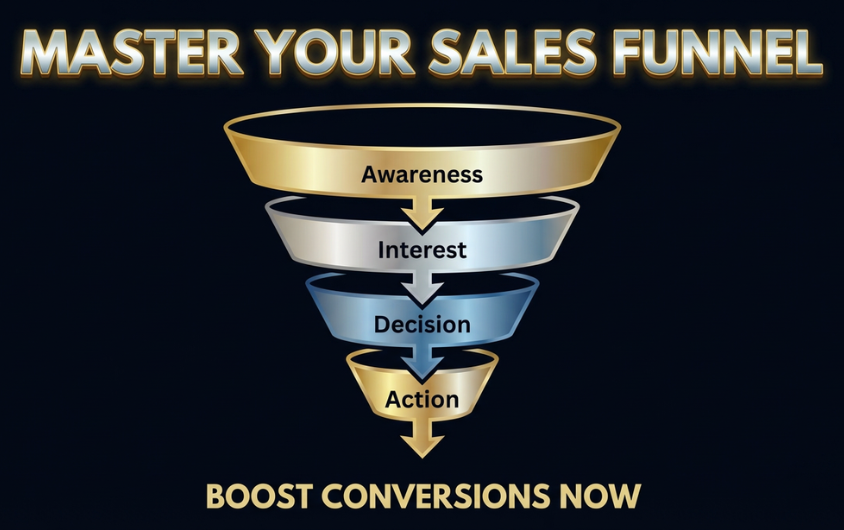
What Is a Sales Funnel?
A sales funnel strategy is a step-by-step process that turns strangers into paying customers.
It’s called a “funnel” because:
- Many people enter at the top
- Fewer people move down
- Only a small percentage convert into customers
A proper sales funnel helps businesses:
- Attract the right audience
- Build trust
- Nurture leads
- Increase conversions
Without a clear funnel, you are just generating traffic — not revenue.
The 4 Main Stages of a Sales Funnel (Awareness to Conversion)
Every high-converting sales funnel follows these stages:
1. Awareness Stage (Top of Funnel – TOFU)
This is where people first discover your brand.
They might find you through:
- Blog posts
- Social media
- SEO
- Ads
At this stage, users are not ready to buy. They are looking for information.
Goal: Educate and attract.
Example:
A user searches for “how to generate B2B leads” and finds your blog.
2. Interest Stage (Middle of Funnel – MOFU)
Now the user knows about you and wants to learn more.
They may:
- Download a free guide
- Subscribe to your email list
- Attend a webinar
Goal: Build trust and provide value.
This is where your sales funnel strategy becomes powerful. You nurture the lead instead of pushing a sale.
3. Decision Stage
The user is comparing options.
They might:
- Check your pricing
- Read case studies
- Compare competitors
Goal: Show proof and credibility.
Add:
- Testimonials
- Case studies
- Results
- Clear benefits
4. Conversion Stage (Bottom of Funnel – BOFU)
This is where the user becomes a customer.
They:
- Book a call
- Purchase a product
- Sign a contract
Your funnel should make this step simple and friction-free.
Funnel Optimization Tips to Increase Conversions
Building a funnel is not enough. You must optimize it regularly.
Here are practical funnel optimization tips:
1. Improve Landing Page Clarity
- Clear headline
- One main CTA
- No distractions
Confusing pages reduce conversions.
2. Use Lead Magnets
Offer:
- Free ebooks
- Checklists
- Templates
- Free audits
This increases email sign-ups and lead capture rate.
3. Add Social Proof
People trust people.
Add:
- Testimonials
- Reviews
- Client results
- Case studies
This strengthens your sales funnel strategy.
4. Use Email Nurturing Sequences
Don’t expect users to buy instantly.
Create:
- Welcome emails
- Educational emails
- Case study emails
- Offer emails
Consistent nurturing improves conversion rate.
5. Track Funnel Metrics
Important metrics:
- Conversion rate
- Bounce rate
- Cost per lead
- Customer acquisition cost
Data helps improve weak stages in the funnel.
Real Case Studies of High-Converting Sales Funnels
Case Study 1: B2B Agency Funnel
A marketing agency created:
- SEO blog content (Awareness)
- Free lead magnet (Interest)
- Case studies (Decision)
- Strategy call CTA (Conversion)
Result:
- 40% increase in qualified leads
- 25% higher conversion rate
Case Study 2: SaaS Company Funnel
A SaaS startup used:
- Educational LinkedIn content
- Free trial offer
- Email nurturing
- Demo booking CTA
Result:
- 3× trial sign-ups
- Lower customer acquisition cost
Case Study 3: E-commerce Funnel
An e-commerce brand optimized:
- Retargeting ads
- Abandoned cart emails
- Simplified checkout
Result:
- 18% increase in sales
- Improved customer retention
Why a Strong Sales Funnel Strategy Matters
Today’s customers don’t buy instantly.
They:
- Research
- Compare options
- Read reviews
- Check credibility
Before making a decision, buyers want to feel confident and informed.
A well-structured sales funnel strategy ensures that every stage supports the customer journey — from awareness to final purchase.
When each step is planned properly, you:
- Build trust
- Guide prospects smoothly
- Increase conversions
- Reduce drop-offs
Without a clear funnel, potential customers leave at different stages — and you lose valuable business opportunities.
Final Thoughts
A strong sales funnel strategy is not optional anymore — it is essential for sustainable growth.
When you:
- Understand your audience
- Create value at each stage
- Optimize continuously
Your funnel turns traffic into leads and leads into revenue.
FAQs: Sales Funnel Strategy
Got questions? Get answers
A sales funnel strategy is a structured marketing process that guides potential customers from awareness to purchase. It includes stages like awareness, interest, decision, and conversion to increase leads and revenue.
To create a high-converting sales funnel:
- Define your target audience
- Create awareness content
- Offer a lead magnet
- Nurture leads with email marketing
- Optimize landing pages
- Track and improve performance regularly
A sales funnel works by guiding potential customers from awareness to purchase. It attracts visitors, builds trust through valuable content, nurtures leads with emails or offers, and encourages them to take action. A strong sales funnel strategy helps increase conversions and generate consistent business growth.
Common reasons include:
- Poor landing page design
- Weak value proposition
- No lead nurturing
- Lack of social proof
- Complicated checkout process
Improving these areas can increase conversion rates.
Popular tools include:
- Landing page builders
- Email marketing software
- CRM tools
- Analytics tools
The best tool depends on your business goals and budget.
A sales funnel may start generating results within a few weeks, but consistent optimization is required for long-term growth and higher conversions.